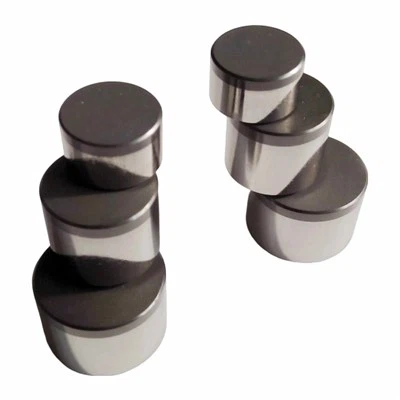
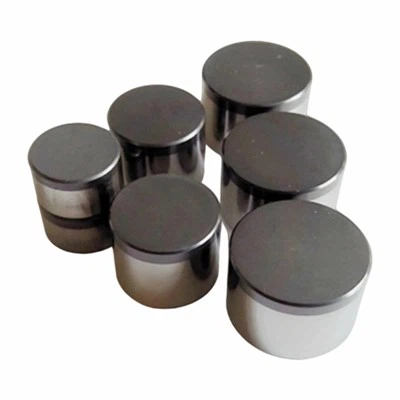
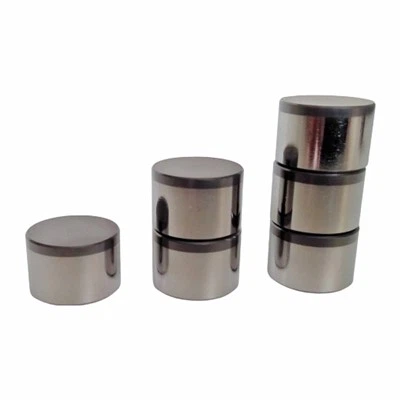
In mining engineering, the practicality of rock-breaking tools directly determines mining efficiency, cost control, and operational safety. PDC (polycrystalline diamond composite) cutters for mining engineering, with their advantages in material composites, shearing rock-breaking mechanisms, and customizable designs, demonstrate significant practical applicability in various mineral and rock conditions and operational scenarios, becoming a crucial link between advanced technological achievements and the needs of mine production.
Their practicality is primarily reflected in their high-efficiency rock breaking and significant speed increase. The surface polycrystalline diamond layer of the PDC cutter has extremely high hardness, and combined with continuous shearing cutting, it can achieve low-energy, high-speed cutting in homogeneous sandstone, shale, limestone, and some hard and brittle ores. Field applications demonstrate that in medium-hard and lower-hard ores, its mechanical drilling speed is 2-5 times higher than traditional roller cone or carbide insert bits, significantly increasing the footage per hole. This translates to substantial reductions in work duration and increased equipment utilization for continuous operations such as coal mine gas extraction holes, metal mine exploration holes, and tunnel excavation.
Secondly, its wear resistance and long service life enhance its practical value. The excellent wear resistance of the diamond layer keeps the cutting edge sharp during prolonged operation, reducing the increase in cutting force and energy consumption caused by wear. The impact toughness provided by the carbide matrix allows it to work stably in complex geological conditions such as interlayers, gravel-bearing areas, or discontinuous fractures, extending the drill bit replacement cycle and reducing non-productive time and auxiliary operation frequency, thereby effectively controlling overall costs in large-scale mining and deep-hole drilling.
Thirdly, its adaptability to various working conditions and operational stability expand its application scenarios. Mining operations often face environments with high temperatures, high humidity, dust, and impact loads. The thermal stability of PDC cutters (due to the high thermal conductivity and low coefficient of thermal expansion of diamond) can withstand performance degradation caused by high temperatures in deep holes. Their composite structure buffers high-frequency impacts, and the flexible design of their geometry and array can match the needs of different hole diameters, depths, and rock hardness, ensuring a regular borehole trajectory, reducing the risk of deviation and stuck drill, and improving operational safety.
Fourthly, the comprehensive economic and environmental benefits further highlight their practicality. High efficiency and long lifespan directly reduce material and energy consumption per unit of drilling depth, minimizing disruption to production rhythm caused by tripping and drill changing operations. Smooth shearing and cutting reduce drill string vibration and disturbance to the wellbore or borehole wall, which is beneficial for surrounding rock stability and subsequent support operations. It also reduces abnormal dust and cuttings generation, aligning with the requirements of green mine construction.
Compared to roller cone drill bits, PDC cutters offer significant advantages in soft to medium-hard ores; compared to pure carbide teeth, their wear resistance and thermal stability are more competitive; and compared to emerging superhard cutting tools, their composite structure exhibits superior resistance to rock breaking and reliable service in the dynamic impact environment of downhole drilling.
In summary, the practicality of PDC cutters in mining engineering lies in the organic unity of their efficient rock breaking, long-term wear resistance, wide adaptability, and comprehensive economic and environmental advantages. They effectively address the diverse demands of mining production for speed, cost, safety, and quality, and have a solid and continuously expanding application prospect in modern mining engineering.