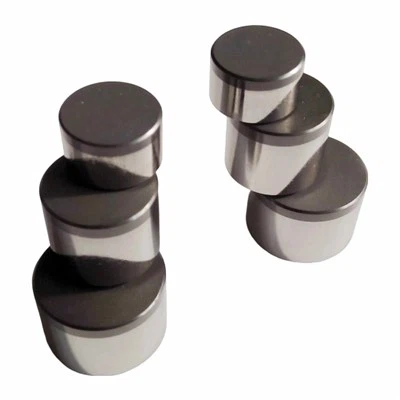
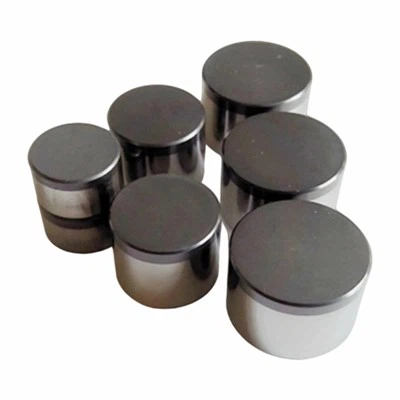
Your Professional Thermal Stable PCD Supplier
Henan Deqin New Material Co., Ltd. specializes in the R&D and manufacturing of PDC cutters for oil & gas drilling, mining, and construction applications. The company operates dedicated production lines and modern factory facilities supported by advanced manufacturing and inspection systems. Core equipment includes high-pressure synthesis machines, Scanning Electron Microscopes (SEM), Energy Dispersive Spectrometers (EDS), and X-ray Diffractometers (XRD), ensuring reliable quality control and product consistency. With strong technical expertise and continuous process improvement, DQ provides dependable PDC solutions for global industrial customers.
-
![Nickel Coated TSP Diamond]() Nickel Coated TSP DiamondNickel coated TSP Diamond(Thermally Stable Polycrystalline Diamond) is a special superhard material designed specifically for extreme thermal conditions and high-strength brazing requirements.
Nickel Coated TSP DiamondNickel coated TSP Diamond(Thermally Stable Polycrystalline Diamond) is a special superhard material designed specifically for extreme thermal conditions and high-strength brazing requirements. -
![Thermal Stable Polycrystalline Diamond]() Thermal Stable Polycrystalline Diamond1. High wear resistance. 2. High-temperature stability. 3. Reduced risk of cracking, extending tool life. 4. Improved impact toughness through optimized force distribution.
Thermal Stable Polycrystalline Diamond1. High wear resistance. 2. High-temperature stability. 3. Reduced risk of cracking, extending tool life. 4. Improved impact toughness through optimized force distribution. -
![TSP Diamond]() TSP Diamond1. High wear resistance. 2. High-temperature stability. 3. Reduced risk of cracking, extending tool life. 4. Improved impact toughness through optimized force distribution.
TSP Diamond1. High wear resistance. 2. High-temperature stability. 3. Reduced risk of cracking, extending tool life. 4. Improved impact toughness through optimized force distribution.


Why Choose Us
Our Certificate
Our products have passed ISO9001 certification in 2016, ensuring standardized production and reliable quality management.
Quality Control
A full end-to-end quality control system is applied from raw material analysis to final inspection. Multiple performance tests ensure stable and dependable PDC quality.
Sales Market
Our products are exported to the United States, Canada, Russia, Germany, Australia, and South Korea. Long-term cooperation reflects stable quality and trusted service.
OEM & ODM Capability
Our provides flexible OEM and ODM services based on customer requirements. Strong manufacturing experience supports customized PDC solutions and efficient technical communication.
Thermal Stable Polycrystalline Diamond
Thermally stable polycrystalline Diamond is a diamond polymer made by sintering diamond and bonding agent under high temperature and high pressure. It has extremely high heat resistance and high thermal stability. The shape is triangular, square, rectangular, cylindrical, arc at both ends, and its diversification is suitable for various drilling tools and geological requirements. It is an ideal material for providing wear protection for petroleum / geological drill bits and sucker rod reamers.
|
Thermal Stable Polycrystalline Diamond cutter specifications |
||||
|
Cylinder/button shape Diameter x Height x Angle (mm) |
||||
|
1x1.2x120° |
1.5x2x120° |
1.5x4x180° |
2x4x120° |
2x4x180° |
|
3x3x180° |
3x8x120° |
3x8x180° |
4x4x180° |
4x10x120° |
|
4x10x180° |
5x10x120° |
5x10x180° |
6x10x120° |
6x10x180° |
|
8x3x180° |
8x5x180° |
10x0.75x180° |
10x1x180° |
10x2x180° |
|
Rectangle/cube shape Length x Widthx Height (mm) |
||||
|
1.5x1.5x1.5 |
1.5x1.5x4 |
1.5x1.5x5 |
1.5x1.5x10 |
2.5x2.5x2.5 |
|
3x3x3 |
3x3x10 |
3x5x10 |
3x6x10 |
4x4x4 |
|
4x6x10 |
5x5x5 |
5x5x10 |
10x10x10 |
|
|
Triangle shape Length1 x Length2 x Length3 x Height (mm) |
||||
|
4x4x4x2.6 |
5x5x5x3 |
6x6x6x3.5 |
6x6x6x4 |
6x6x6x4.5 |
|
Special shape(oval shape) Width x Height x Radius (mm) |
||||
|
3x3x10xR1.5 |
5x5x10xR3 |
5x10x20xR7 |
|
|

Heat resistance and thermal stability
TSPhas a thermal stability of more than 1200°C, which allows it to maintain itsperformance in high-temperature environments and is suitable for work underextreme temperature conditions. This feature makes TSP very suitable for use inoil drilling and geological exploration.
Wear resistance and impact toughness
TSPexhibits extremely high wear resistance, with a wear rate of 80,000 to 120,000.This means that in high-intensity grinding and cutting operations, TSP caneffectively extend the service life of the tool. In addition, TSP also hasexcellent impact toughness and can withstand instantaneous impact loads.
Chemical inertness and thermal expansion
TSP'sbinder has good chemical inertness and can effectively resist the erosion of avariety of corrosive media. At the same time, its thermal expansion coefficientis similar to that of diamond, which means that during thermal cycling, TSP hasstronger thermal stability and maintains good dimensional stability andstructural integrity.
Type of Thermal Stable Polycrystalline Diamond
CVD diamonds
Chemical vapour deposition diamonds diamonds are produced through a controlled chemical process that deposits carbon atoms onto a substrate layer. This method allows for the precise control of the diamond's size, shape, and quality.
PCD diamonds
PCD, which stands for polycrystalline diamond, consists of a synthetic material created by sintering diamond particles under high pressure and temperature. The process forms a solid, integrated mass of diamond, which is extremely hard and wear-resistant.
Nanocrystalline diamonds
As the name suggests, these are relatively new synthetic diamonds that have seen an expansion in the market recently. They are produced by sintering fine diamond powders. The result is a material that combines the hardness of a diamond with increased toughness and wear resistance.

Application of Thermal Stable Polycrystalline Diamond

Mining
TSP's wear resistance and highhardness make it an ideal material in mining, used to manufacture drill bits,cutting tools, etc.

Metal processing
TSP is used tomanufacture various metal cutting tools, wire drawing dies, etc., to improvethe efficiency and accuracy of metal processing.

Geological exploration
TSP is used tomanufacture detection tools in geological exploration equipment to improve theefficiency and accuracy of exploration.
Materials and Ingredients of Thermal Stable Polycrystalline Diamond
The composition of thermal stable polycrystalline diamond involves a variety of materials, each imparting distinct properties. Natural abrasives, such as garnet and emery, are valued for their affordability and effectiveness in various applications.
Synthetic abrasives, including aluminum oxide and silicon carbide, offer superior hardness and durability, making them suitable for high-performance tasks. The choice of materials impacts the abrasive's ability to withstand wear and tear, its cutting speed, and its compatibility with different substrates.
Additionally, bonding agents and fillers are incorporated to enhance the structural integrity and performance of thermal stable polycrystalline diamond. As sustainability becomes a priority, eco-friendly materials are increasingly being explored to reduce environmental impact.
Production Process of Thermal Stable Polycrystalline Diamond


High Pressure High Temperature Sintering
Pure diamond micro-powder (free of metal catalysts) is placed in a HPHT apparatus. At pressures of 5–8 GPa and temperatures of 1400–2000°C, diamond grains directly bond to each other without a metallic binder. This creates a rigid polycrystalline structure with strong diamond-to-diamond (D-D) bonds. The absence of cobalt or iron allows the material to withstand temperatures up to 1200°C without graphitization.
Acid Leaching of Metallic Catalyst
Conventional PCD is first made using a cobalt binder. The compact is then immersed in a hot acid mixture (e.g., nitric and hydrofluoric acids) for several hours to days. The acid dissolves the interconnected cobalt network, leaving behind a pure diamond skeleton with open pores. This chemically treated material becomes thermally stable because no metal remains to catalyze graphite formation at high temperatures.
Liquid Carbonate Infiltration
A porous diamond preform is placed next to a carbonate source such as MgCO₃ or CaCO₃. Under HPHT conditions (approx. 5 GPa, 1400°C), the carbonate melts and infiltrates the diamond layer. Carbonates do not promote diamond graphitization. Upon cooling, the carbonate solidifies as a stable, non-catalytic binder, yielding a TSPCD that retains high hardness and thermal stability up to 1200°C.
Silicon Carbide (SiC) Bonding
Diamond grit is mixed with silicon powder and heated to about 1400–1500°C under vacuum or low pressure. Molten silicon reacts with the diamond particle surfaces to form silicon carbide (SiC). The SiC bridges the diamond grains together without any cobalt. This process produces a thermally stable polycrystalline structure widely used in drill bits and high-temperature cutting tools, as it resists graphitization and oxidation.
Boron-Doping Assisted Sintering
Boron powder is added to diamond micro-powder before HPHT sintering. Under high pressure and temperature, boron diffuses into diamond grain boundaries and forms boride compounds. This promotes direct D-D bonding and increases oxidation resistance. The resulting TSPCD is electrically conductive, allowing electrical discharge machining (EDM) of complex shapes while maintaining excellent thermal stability.
Maintenance

Surface Cleaning and Contamination Prevention
Cleaning Agents: Clean with mild alkaline solutions (pH 8-10) or deionized water. Avoid strong alkali melts or concentrated hydrofluoric acid, as these can attack the residual non-diamond phases (e.g., carbonates or carbides).
Built-Up Edge (BUE): Remove any workpiece material adhered to the TSPCD surface using a soft abrasive stone or ultrasonic cleaning. Do not use steel tools to scrape the surface, as this might induce micro-fractures.
Storage and Environmental Control
Humidity: Store in a dry environment (relative humidity < 60%). Prolonged exposure to high humidity can lead to hydrolysis of certain binder phases (such as carbonates or silicon carbide interlayers), reducing mechanical strength.
Contact: Keep TSPCD components separated to prevent direct diamond-on-diamond contact during storage, which can cause impact damage or edge dulling.
Inspection for Thermal Degradation
Color Change: A shift from dark gray/black to a chalky white surface indicates oxidation or graphitization has occurred.
Edge Integrity: Check for micro-chipping or rounding of cutting edges using a 20x-50x microscope.
Performance Drop: If cutting forces increase noticeably, it may indicate thermal fatigue; re-sharpen immediately to prevent catastrophic failure.
FAQ
As one of the most professional thermal stable pcd manufacturers in China, our products have good reputation in the market. Please feel free to buy high quality thermal stable pcd for sale here from our factory. For price consultation, contact us.
Popular Products