Introduction
Deep-sea pumps serve as core equipment in offshore resource exploitation, subsea oil and gas transportation, and oceanographic research. Their bearing systems endure long-term exposure to extreme operational conditions-including ultra-high pressure, low temperatures, intense corrosion, and abrasive media-making conventional metal or ceramic bearings incapable of meeting long-service-life and zero-maintenance requirements. Following years of intensive R&D, DQ DIAMOND has successfully developed high-performance PCD (Polycrystalline Diamond) bearings customized for deep-sea pumps, delivering a revolutionary material solution for severe subsea wear environments.
I. Application Domains & Environmental Characteristics of Deep-Sea Pumps
Deep-sea pumps are extensively deployed for fluid, slurry, or multiphase mixture conveyance under subsea high-pressure, corrosive, and cryogenic environments. Key applications include:
Deep-sea mineral extraction (slurry lifting), subsea oil & gas field boosting, natural gas hydrate extraction testing, deep-sea core drilling, ROV/HOV hydraulic power drives, seabed pipeline pre-commissioning, deep-sea salvage and emergency rescue, deep-water dredging, subsea carbon capture and storage (CCS) injection, pressure-retaining oceanographic sampling, deep-sea station environmental control systems, seabed observation network flushing, and offshore deep-sea aquaculture operations.
The deep-sea environment presents the following critical operational challenges:
- High Hydrostatic Pressure: At a water depth of 6,000 meters, static pressure reaches approximately 60 MPa. Bearings and their lubrication chambers must feature extreme pressure capability or dynamic pressure-compensation designs.
- Cryogenic Temperatures: Benthic seawater temperature typically ranges between 2°C and 4°C, requiring materials that resist low-temperature embrittlement.
- Severe Corrosion: Seawater contains abundant chloride ions and dissolved oxygen, triggering rapid pitting and crevice corrosion on metallic components.
- Abrasive Slurry Wear: Pumping media in mining and drilling operations contain high concentrations of silt, sand, and hard mineral particles.
- Maintenance Hurdles: Subsea equipment intervention incurs astronomical costs, demanding bearing operational lifespans of tens of thousands of hours without maintenance.


Figure 2: Deep-sea environmental parameter profile (Water Depth vs. Hydrostatic Pressure vs. Temperature relationship chart)
II. Technical Requirements for Deep-Sea Pump Bearings

II. Technical Requirements for Deep-Sea Pump Bearings
To ensure long-term stability under severe marine conditions, subsea pump bearings must fulfill stringent engineering specifications:
- Superior Seawater Corrosion Resistance: Total immunity to chloride-induced pitting, galvanic, and stress corrosion.
- Ultra-High Hardness & Wear Resistance: Sustained resistance against severe three-body abrasive wear.
- High Load Capacity & Dimensional Stability: Resilience against multi-ton axial thrust and radial forces under high static pressure.
- Reliable Water-Lubrication Capability: Self-lubricating characteristics utilizing ambient seawater without external oil grease.
- Impact Toughness & Thermal Stability: Sufficient fracture toughness to absorb operational vibrations alongside high thermal conductivity to dissipate frictional heat.
- Zero-Maintenance Longevity: Near-zero wear rates enabling tens of thousands of hours of continuous service.
III. Technical Features of DQ DIAMOND PCD Bearings
DQ DIAMOND PCD bearings utilize high-purity polycrystalline diamond compacts as their core tribological interface, exhibiting the following core technical features:
1. Extreme Hardness & Superior Wear Resistance
PCD features a Vickers hardness of 6,000–8,000 HV, which is 4 to 5 times higher than cemented carbide (tungsten carbide) and 2 to 3 times higher than silicon carbide (SiC) ceramics. Under sand-laden seawater slurry erosion, its volumetric wear rate is 1 to 2 orders of magnitude lower than cemented carbide (reaching the 10⁻⁵ mm³/(N·m) order), substantially extending bearing service life.
2. Ultra-Low Friction Coefficient under Water Lubrication
When lubricated by seawater, PCD exhibits an exceptionally low friction coefficient of 0.05–0.10, significantly lower than the metal-to-metal or metal-to-carbide friction pair (0.2–0.5). Low friction drastically minimizes pump startup torque and running power consumption-a critical benefit for power-constrained subsea equipment such as ROVs.
3. High Load-Bearing Capacity & Thermal Conductivity
PCD possesses an ultra-high compressive strength of 7–8 GPa, easily absorbing multi-ton axial hydraulic thrusts generated by high-head pump impellers. Its exceptionally high thermal conductivity (500–2,000 W/(m·K)) rapidly conducts away frictional heat, eliminating localized hot spots. Coupled with a low coefficient of thermal expansion (2–4 × 10⁻⁶/°C), it maintains supreme dimensional accuracy.
4. Chemical Inertness & Zero Maintenance
PCD is chemically inert to seawater, salt spray, and dissolved oxygen, eliminating galvanic corrosion risks. Its naturally hydrophilic surface facilitates the immediate formation of a stable hydrodynamic water film, allowing long-term operation directly in seawater without complex mechanical seals or external oil lubrication systems.
5. Modular Inlaid Structural Architecture
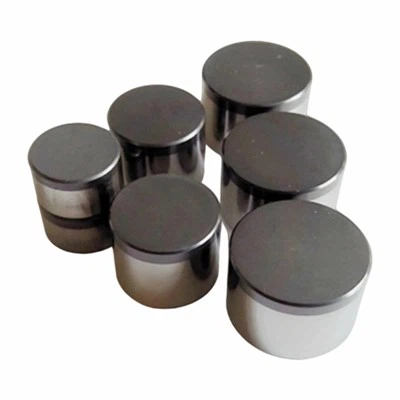
To overcome the manufacturing limitations of monolithic diamond components, DQ DIAMOND employs an advanced inlaid structural design. PCD diamond tables are sintered onto a tungsten carbide substrate (PDC elements), which are then brazed or mechanically locked into the bearing housing-perfectly combining the extreme wear resistance of PCD with the high fracture toughness of the carbide backing.

Figure 4: Volumetric wear rate comparison chart: PCD vs. Cemented Carbide vs. SiC Ceramics (Quantitative Data Support)
Table 1: Performance Metric Comparison of Key Bearing Materials
|
Performance Metric |
PCD (DQ DIAMOND) |
Cemented Carbide |
SiC Ceramic |
Si₃N₄ Ceramic |
Duplex Stainless Steel |
Engineering Plastics |
|
Hardness (HV) |
6,000–8,000 |
1,300–1,800 |
2,400–2,800 |
1,500–1,800 |
250–350 |
Extremely Low |
|
Water Friction Coeff. |
0.05–0.10 |
0.2–0.4 |
0.05–0.15 |
0.05–0.15 |
0.3–0.5 |
0.08–0.15 |
|
Wear Rate |
Ultra-Low (10⁻⁵) |
Moderate (10⁻³) |
Low (10⁻⁴) |
Low (10⁻⁴) |
High |
Moderate-High |
|
Compressive Strength (MPa) |
7,000–8,000 |
4,000–6,000 |
2,500–4,000 |
3,000–4,000 |
500–800 |
100–200 |
|
Fracture Toughness (MPa·m¹/²) |
6–9 (Brittle) |
10–15 (Tough) |
3–5 (Brittle) |
5–7 (Brittle) |
> 50 (Very Tough) |
> 2 (Ductile) |
|
Thermal Cond. (W/m·K) |
500–2,000 |
80–100 |
100–150 |
20–30 |
15–20 |
0.25 |
|
Seawater Corrosion Res. |
Excellent |
Moderate (Cobalt phase) |
Excellent |
Excellent |
Good (Pitting risk) |
Excellent |
|
Relative Cost |
Very High |
Moderate |
Moderate-High |
High |
Low |
Low |
IV. Comparative Analysis with Common Subsea Bearing Materials
Common materials currently employed in subsea pump bearings include tungsten carbide (WC-Co), silicon carbide (SiC) ceramics, silicon nitride (Si₃N₄) ceramics, super duplex stainless steel, nickel-based alloys, and engineering polymers (PEEK/PTFE). A performance synthesis highlights key distinction factors:
- Wear Resistance: PCD surpasses tungsten carbide by over an order of magnitude and SiC by multiple folds, proving unparalleled for severe abrasive wear conditions.
- Frictional Behavior: PCD matches SiC/Si₃N₄ ceramics under water lubrication while significantly outperforming metallic and polymeric materials.
- Load Capacity: PCD's compressive strength far exceeds all competing engineering materials, though its fracture toughness is lower than metals and cemented carbides.
- Corrosion Resistance: PCD, SiC, and Si₃N₄ exhibit complete chemical inertness, avoiding the leaching or pitting risks inherent in metallic alloys.
- Economic Evaluation: While PCD carries higher initial procurement costs, it delivers the lowest total cost of ownership (TCO) through extended maintenance-free service intervals.

V. Project Suitability & Application Guidelines for DQ DIAMOND PCD Bearings
DQ DIAMOND PCD bearings are highly recommended for demanding subsea projects, including:
- Deep-Sea Mining Lift Pumps: Slurries contain heavy concentrations of polymetallic nodules and quartz sand; PCD bearings resist aggressive abrasion and extend operational life multi-fold.
- Subsea Mud & Drill Cuttings Pumps: Utilized in offshore drilling and natural gas hydrate trial production where media carries rock cuttings and abrasive sand.
- Subsea Dredging Pumps: Suction pumping of sand-laden silt where PCD's low hydrodynamic friction reduces overall electrical energy consumption.
- Seabed Multiphase Boosting Pumps: Provides dependable load support when handling sand-contaminated oil-gas-water fluids.
Engineering Selection Note:
For clean-water pumps, fire pumps, or seawater circulation pumps where fluid media is devoid of abrasive solids, standard SiC ceramics or polymeric water-lubricated bearings offer sufficient performance with higher cost efficiency. Therefore, DQ DIAMOND specifically recommends PCD bearings for high-wear, heavy-thrust, and particle-laden water-lubricated journal and thrust bearing assemblies. Through optimized modular inlays and elastic backing supports, engineers can overcome inherent material brittleness while ensuring particle size control (recommended < 1 mm) and shock load damping.

Figure 6: Assembly schematic of DQ DIAMOND PCD bearing in a deep-sea mining slurry lift pump (showing thrust and radial bearing arrangements)
Conclusion
Featuring ultra-high hardness, exceptionally low hydrodynamic friction, superior wear resistance, and complete chemical inertness, DQ DIAMOND PCD diamond bearings establish the benchmark for severe-service subsea pumps. In critical deep-sea mining, mud transport, and cuttings conveyance applications, PCD bearings dramatically boost equipment reliability while lowering lifecycle operational costs. We warmly welcome domestic and international partners to engage in technical exchange, custom prototyping, and joint field trials to advance high-performance subsea equipment technology.
FAQ
Q: What are DQ DIAMOND PCD bearings for deep-sea pumps?
A: DQ DIAMOND PCD bearings are high-performance water-lubricated bearings developed for deep-sea pumps operating under high pressure, low temperature, seawater corrosion, and abrasive slurry conditions. The bearing uses polycrystalline diamond (PCD) as the primary tribological material and a tungsten carbide backing structure, combining the extreme wear resistance of PCD with the mechanical support of carbide. They are designed for demanding subsea journal and thrust bearing applications where long service life and low maintenance are required.
Q: Why are PCD bearings suitable for deep-sea pump applications?
A: PCD offers extremely high hardness, excellent abrasive wear resistance, low friction under water lubrication, high compressive strength, high thermal conductivity, and strong resistance to seawater corrosion. DQ DIAMOND PCD bearings have a reported hardness of 6,000–8,000 HV and a water-lubricated friction coefficient of approximately 0.05–0.10. These properties make PCD particularly suitable for subsea pumps handling abrasive, particle-laden fluids where conventional metal bearings may experience corrosion and accelerated wear.
Q: Can DQ DIAMOND PCD bearings operate with seawater lubrication without external oil or grease?
A: Yes. DQ DIAMOND PCD bearings are designed for water-lubricated operation and can utilize ambient seawater as the lubricating medium. The PCD surface has a low friction coefficient under water lubrication and is resistant to seawater, salt spray, and dissolved oxygen. This design can reduce dependence on external oil or grease lubrication systems and is particularly suitable for subsea equipment where lubrication and maintenance access are difficult.
Q: What deep-sea pump applications are suitable for DQ DIAMOND PCD bearings?
A: DQ DIAMOND PCD bearings are intended for high-wear and heavy-load subsea pump applications, including deep-sea mining slurry lift pumps, subsea mud and drill-cuttings pumps, subsea dredging pumps, and seabed multiphase boosting pumps. They are especially suitable when the pumped medium contains abrasive particles such as sand, silt, rock cuttings, or mineral particles. For clean-water, fire, or seawater circulation pumps without abrasive solids, conventional SiC or polymeric water-lubricated bearings may provide a more cost-efficient solution.
Q: What bearing types and structures can DQ DIAMOND provide for deep-sea pumps?
A: DQ DIAMOND PCD bearings can be engineered for both journal/radial bearing and thrust bearing assemblies used in subsea pumps. The PCD elements are integrated with a tungsten carbide substrate and then brazed or mechanically locked into the bearing housing. This modular inlaid structure is designed to combine PCD's high wear resistance with the supporting and shock-damping characteristics of the backing structure. Bearing geometry, dimensions, PCD configuration, and support structure can be customized according to pump load, shaft dimensions, operating pressure, temperature, fluid composition, particle concentration, and other application requirements.