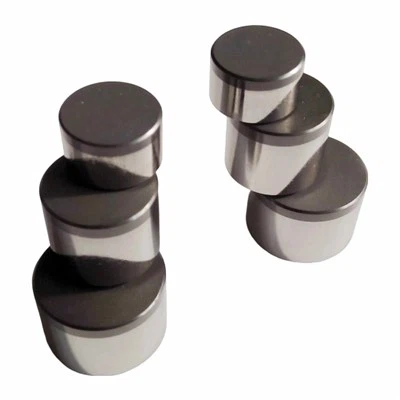
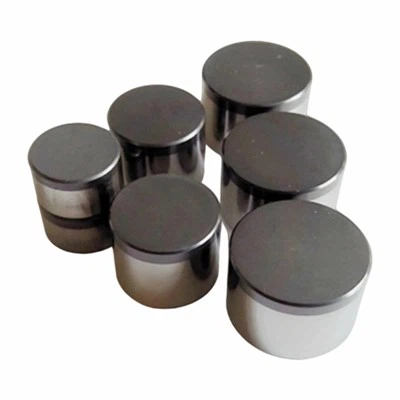
In the field of high-performance PDC Cutter manufacturing, "leaching" is a key chemical process in the post-processing stage, with the core being the directional removal of residual cobalt metal in the polycrystalline diamond layer to enhance thermal stability.
During HPHT PDC sintering, cobalt acts as a catalyst to promote the formation of stable covalent bonds between diamond particles. However, although the residual cobalt in the finished teeth can improve overall toughness, there are hidden dangers of thermal degradation. The thermal expansion coefficients of cobalt and diamond differ by nearly 10 times. When the temperature of underground drilling exceeds 700 ℃, the deformation difference between the two will cause severe internal stress, leading to the collapse and detachment of the diamond layer, greatly shortening the life of the drill bit cutting teeth. The leaching process utilizes acidic etching reagents to selectively dissolve cobalt elements on the surface of diamond, reducing the risk of high-temperature deformation mismatch from the root.

The PDC leaching process is divided into three levels: shallow (20-50 $\mu$m), moderate (50-100 $\mu$m), and deep (above 100 $\mu$m), which are suitable for different rock formation conditions. Shallow leaching teeth consider both impact resistance and heat resistance, suitable for drilling in medium hard sandstone and limestone formations; The thermal stability of deep leached PDC cutters has been improved by more than 40%, making it suitable for high-temperature operation scenarios such as high abrasive hard formations and shale gas horizontal wells.