Product Description
Water diversion tunnel projects often span mountain ranges and river valleys, with depths of several hundred meters and highly uncertain geological conditions. The construction section frequently crosses extremely hard rock layers such as granite and quartzite, with uniaxial compressive strength often exceeding 150MPa, quartz content of over 60%, and extremely strong abrasion resistance; At the same time, accompanied by fault fracture zones, alteration zones, and high-pressure groundwater, the integrity of the rock mass varies greatly. This complex formation of "hard rock interbedded with soft layers and rich water accompanied by fragmentation" imposes almost stringent durability requirements on excavation equipment.

Construction characteristics and cutting performance requirements
The construction of the water diversion tunnel is mainly carried out by full section tunnel boring machine (TBM) or drilling and blasting method, and TBM method requires higher stability of the cutting teeth. Due to the deep burial depth of the tunnel and strict support requirements, excavation needs to be continuous, and tool wear and downtime affect the project schedule. So, the cutting teeth need to have:
- High wear resistance and impact resistance: Dealing with highly abrasive minerals such as quartz in hard rock formations.
- Thermal stability: prevent the diamond layer from graphitizing due to high temperature during high-speed excavation.
- Structural adaptability: Match with cutterhead layout and excavation parameters to reduce abnormal losses.
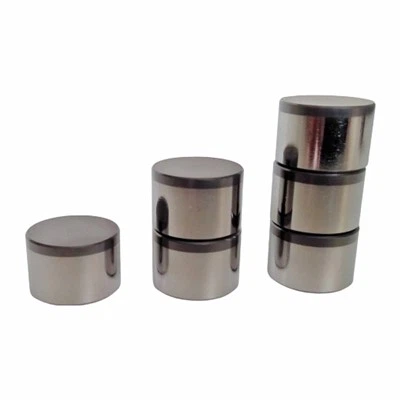
Based on these characteristics, diamond composite disc (PDC) cutters are an ideal choice. Their polycrystalline diamond layer has high hardness (≥ 90 GPa), the hard alloy matrix has toughness, and self sharpening can reduce excavation resistance. The composite structure can withstand dynamic loads from hard rock.
Characteristics of DQ Diamond Cutting Teeth for Water Diversion Tunnel
Innovative Materials and Design
- Multi layer composite interface technology: By enhancing the bonding force between PDC and matrix through gradient transition layer, it avoids delamination failure under hard rock impact.
- Customized diamond particles: using coarse-grained, high-purity diamond micro powder to enhance wear resistance and control crack propagation.
- Fluid dynamics groove design: The cutting head is designed with a guide groove to assist in slag discharge, reduce rock powder adhesion, and minimize heat accumulation.
Special Structure and Function
- Anti water erosion sealing system: Double stage metal sealing blocks high-pressure water infiltration, and the substrate surface is laser melted with WC-10Co coating, which increases the water erosion resistance by three times.
- Biomimetic rock breaking tooth design: wedge-shaped tooth tips reduce shale excavation vibration, spiral chip groove design increases slag discharge efficiency in the crushing zone by 60%.
- Innovative structure of composite sheet: Gradient interface technology adopts Ti SiC transition layer, which increases the interface bonding strength by 50% (up to 1.8GPa); The ultra coarse particle PDC uses 3mm diamond micro powder, which has three times higher wear resistance than conventional products.
Adapt to special working conditions
For extremely hard rock formations, a design combining a negative rake angle with a diameter of 14mm spherical teeth has been introduced; For the fractured zone, an asymmetric spiral tooth shape is used to reduce lateral force fluctuations by 40%.

Performance advantage
In practical applications, DQ DIAMOND cutters perform excellently:
- Extended lifespan: Compared to conventional hard alloy teeth, the wear rate in granite formations is reduced by about 40%.
- Improvement of excavation efficiency: The optimized tooth design can improve the utilization rate of rock breaking specific power, helping TBM increase daily footage by 15% -20%.
- Adaptability to working conditions: Special coating treatment enhances corrosion resistance and is suitable for high groundwater acidic environments.
The complex geology of the water diversion tunnel requires that the cutting teeth have both "hard wear resistance" and "soft impact resistance" characteristics. DQ Diamond provides a solution that balances efficient rock breaking and long-term stability through material innovation and structural design, providing key technical support for safe and rapid excavation of deep buried long tunnels.
FAQ
Q1: How to ensure that DQ Diamond cutters do not crack when facing granite or quartzite formations with a hardness exceeding 150MPa?
A: A: We adopted multi-layer composite interface technology and Ti SiC gradient transition layer. This structure increases the bonding strength between the PDC diamond layer and the substrate to 1.8 GPa. Compared to traditional cutters, it can effectively absorb the high-frequency impact force during hard rock excavation, completely solving the common problems of layering and falling blocks in high stress environments, ensuring that it is "hard but not brittle".
Q2: How to avoid the failure of diamond cutting teeth due to thermal attenuation in the high-temperature environment of deep buried tunnels?
A: A: The high temperature during excavation can cause diamond graphitization, resulting in rapid wear and tear. DQ DIAMOND has specially designed a fluid dynamics guide groove, which can quickly discharge rock powder and assist in circulating heat dissipation during operation, significantly reducing heat accumulation. Combined with coarse-grained diamond particles with high thermal stability, it ensures that the cutting teeth maintain extremely high self sharpness during high-speed and continuous excavation.
Q3: What special protection does this product have when encountering tunnel conditions such as high-pressure water inflow or acidic groundwater?
A: A: This is one of our core strengths. We have customized a two-stage metal sealed anti water erosion system for the water diversion tunnel and applied laser cladding WC-10Co coating on the substrate surface. This combination punch has increased the water erosion resistance of the cutting teeth by three times, even in long-term exposure to strong water surges or corrosive underground environments, it can protect the internal structure from erosion.
Q4: How much does the use of DQ DIAMOND cutters improve the overall construction period (TBM daily footage)?
A: A: The construction efficiency depends on the "tool changing frequency" and "rock breaking speed". Actual cases have shown that due to the use of biomimetic rock breaking teeth and spiral chip removal design, the utilization rate of rock breaking specific power has been significantly improved. Under the same geological conditions, our cutting teeth can help increase the daily footage of TBM by 15% -20%, while reducing the frequency of wear and tear, downtime, and tool replacement by about 40%.
Q5: Do you have specialized designs for special working conditions such as fault fracture zones or uneven geological formations?
A: A: Yes, there is. We provide a 'working condition adaptation plan': Extremely hard rock: using a negative front angle design with a diameter of 14mm spherical teeth to enhance compressive and wear-resistant properties. Fracture zone/alteration zone: adopting asymmetric spiral tooth shape. This unique shape can reduce lateral force fluctuations by 40%, allowing the cutting teeth to travel smoothly in rock formations with sudden changes, reducing abnormal losses caused by lateral impact
Hot Selling

High Wear-Resistance PDC Diamond Cutter

High Wear Resistance PDC Oil Gas Bit Cutter

Polycrystalline Diamond Cutter

Polycrystalline Diamond PDC Cutter

Step PDC Cutter

PDC Cutter for Stone Cutting

Serrated PDC Cutter

Diamond PDC Pick
Hot Tags: pcd pick for water diversion tunnel, China pcd pick for water diversion tunnel manufacturers, factory