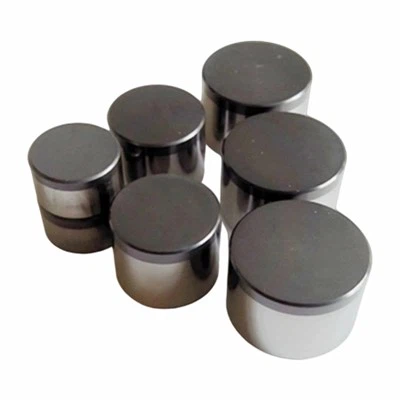
As the core rock-breaking element of modern drilling bits, PDC cutters for oil and gas are not simply formed from a single material, but rather a composite system based on complementary mechanical properties and functional integration.Through the organic combination of a diamond layer and a cemented carbide matrix, and the precise control of multi-level geometric parameters, this construction meets the wear resistance requirements of extreme drilling environments while also considering impact toughness and thermal stability, forming a structural advantage of "combining rigidity and flexibility, offense and defense."
The main structure of the PDC cutter can be divided into two main components: the surface functional layer and the matrix support layer. The surface layer is a polycrystalline diamond layer, formed by sintering diamond particles with a diameter of several micrometers to tens of micrometers with a metal catalyst (usually cobalt, nickel, or their alloys) under high temperature (approximately 1400–1600℃) and high pressure (approximately 5.5–8 GPa). Diamond particles, under catalytic action, interlock to form a continuous three-dimensional network crystal structure, endowing this layer with extremely high hardness and wear resistance, enabling it to directly cut into and shear downhole rock formations. Simultaneously, diamond itself possesses excellent thermal conductivity and a low coefficient of thermal expansion, maintaining dimensional stability under the instantaneous high temperatures generated during high-speed cutting and mitigating thermal damage. The matrix support layer is made of tungsten-cobalt cemented carbide, with tungsten carbide as the framework and cobalt as the binder phase, possessing both high compressive strength and a certain degree of toughness. This allows it to absorb and disperse reaction forces and impact loads from the bottom of the well, preventing the diamond layer from fracturing or detaching due to excessive brittleness. A robust interface is formed between the two layers through metallurgical bonding, ensuring effective load transfer between layers without delamination failure.
In terms of geometry, the shape and dimensions of the PDC cutter have been rigorously optimized to adapt to different drilling conditions. Common shapes include circular, conical, axe-shaped, and stepped irregular shapes, with circular cutters being widely used due to their uniform circumferential stress and mature manufacturing process. The diameter typically ranges from 8 to 19 mm, and can be selected based on the drill bit size and formation hardness. The diamond layer thickness is generally 0.5 to 2.0 mm; increased thickness improves wear life but may reduce crack resistance under hard impact environments. The protrusion height (the distance the diamond layer protrudes from the matrix surface) determines the cutting depth and chip removal space. Too high a height can easily cause impact damage, while too low a height reduces cutting efficiency; it must be matched according to the formation drillability index.
The arrangement of the cutters is also crucial in the overall drill bit design. Multiple PDC cutters are arranged in a radial or helical array on the drill bit crown. The spacing and angle of each cutter are coordinated with the crown profile curve to achieve full bottomhole coverage cutting and reduce the area of repeated impact. High-density tooth arrangement can increase rock breaking rate but increases the risk of matrix heat accumulation and stress concentration; low-density tooth arrangement is beneficial for heat dissipation and impact buffering but may reduce mechanical drilling rate. Therefore, the structural design must strike a balance between cutting efficiency, heat dissipation capacity, and structural durability.
Furthermore, interface structure and post-processing techniques further influence the service performance of the cutter. Some high-end products employ gradient transition layers or multi-layer composite structures, introducing a transition zone with gradually changing composition between the diamond layer and the matrix to alleviate interfacial stress caused by differences in thermal expansion coefficients. Surface microtexturing or laser etching treatments can improve chip removal conditions and reduce the decline in cutting performance caused by rock cuttings adhesion.
In summary, the construction of the PDC cutter is an organic unity of material composites, geometric optimization, and functional layout. It achieves high-efficiency rock breaking and reliable durability through the complementary relationship between the high hardness and wear resistance of the diamond layer and the strong load-bearing capacity of the matrix, and through precise dimensional and layout design, it has become a key technological carrier for addressing the challenges of complex formations in the oil and gas drilling field.