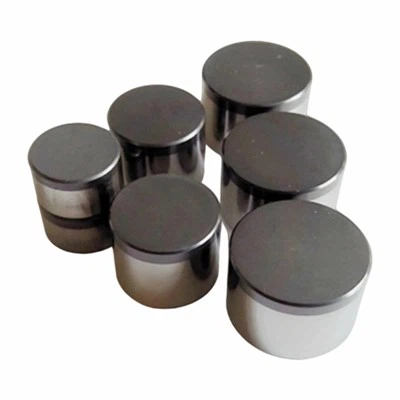
As a core rock-breaking element in modern drilling bits, PDC (Polycrystalline Diamond Composite) cutters for oil and gas applications are characterized by innovative material composite design and working mechanisms, giving them unique performance advantages in complex drilling environments. These features are not only reflected in the physical properties of the material itself, but also in the comprehensive improvement of rock-breaking efficiency, durability, and adaptability to various working conditions, becoming an important factor driving drilling technology innovation.
Firstly, ultra-high hardness and excellent wear resistance are among the most prominent features of PDC cutters. Its surface polycrystalline diamond layer is formed by sintering micron-sized diamond particles under high temperature and pressure, creating a continuous three-dimensional network crystal structure with a hardness reaching 8000–10000 HV, far exceeding that of traditional tungsten carbide teeth and other hard alloy materials. This characteristic enables it to effectively resist abrasion when facing rock formations such as sandstone, shale, and limestone, maintaining the sharpness and integrity of the cutting edge, thus sustaining stable rock-breaking capability during long-term operation and significantly extending drill bit life.
Secondly, the efficient shearing rock-breaking mechanism gives the PDC cutter superior drilling speed. Unlike traditional roller cone bits that rely on impact and crushing to break rock, the PDC cutter uses high-speed relative motion between the diamond layer and the bottom rock surface to continuously scrape and shear, causing plastic deformation and micro-crack propagation in the rock, ultimately breaking it down into fragments. This method has low energy consumption and smooth cutting, making it particularly suitable for soft to medium-hard formations with good homogeneity. It can increase the mechanical drilling rate to 2 to 5 times that of roller cone bits, significantly improving drilling efficiency.
Thirdly, good thermal stability and thermal conductivity constitute important characteristics of the PDC cutter for handling harsh working conditions. Diamond possesses an extremely low coefficient of thermal expansion and excellent thermal conductivity. During high-speed cutting and the resulting instantaneous high temperatures, it can rapidly dissipate heat, slowing down the graphitization of the diamond layer and maintaining structural stability. This characteristic allows the cutter to maintain performance even in high-temperature environments or high-speed operations in deep wells, preventing a decrease in cutting ability or premature failure due to thermal damage.
Fourth, the rigid-flexible composite structure enhances impact resistance and load-bearing reliability. The PDC cutter is metallurgically bonded to a high-hardness diamond layer and a high-toughness cemented carbide matrix. The matrix not only provides mechanical support for the diamond layer but also effectively absorbs and disperses impact loads and bending stresses from the well bottom, preventing brittle spalling or fracture of the surface layer. This composite design balances hardness and toughness, enabling the cutter to maintain a longer service life even in hard interlayers or gravel-bearing formations.
Fifth, the designable geometric diversity and deployment flexibility expand its application adaptability. The PDC cutter can be manufactured in various shapes, including circular, conical, and axe-shaped. Its diameter, diamond layer thickness, and cutting edge height can be adjusted as needed. Through different array arrangements and matching with the crown profile, it achieves full coverage of bottom hole cutting and uniform load distribution. This feature allows the PDC cutter to be optimized according to specific formation characteristics and drilling process requirements, balancing cutting efficiency, heat dissipation, and structural durability.
In summary, the PDC cutter for oil and gas, with its core characteristics of ultra-hard wear resistance, high-efficiency shearing, thermal stability, composite load-bearing capacity, and customizable design, demonstrates significant advantages in improving drilling efficiency, extending drill bit life, and adapting to complex working conditions. It has become an indispensable high-performance rock-breaking tool in the modern oil and gas drilling field.