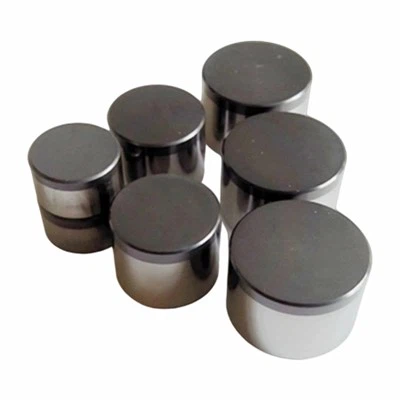
The manufacturing and application of PDC (Polycrystalline Diamond Composite) cutters for mining engineering is a systematic engineering project consisting of a series of closely linked technological processes. The process not only encompasses the precision fabrication of the cutter body but also includes the matching process for assembly with the drill bit and preparation steps for on-site use. Quality control at each stage directly affects the cutter's rock-breaking performance and service life.
The process begins with the synthesis of the polycrystalline diamond layer. High-purity synthetic diamond micro-powder is carefully selected and uniformly mixed with a metal catalyst (such as cobalt, nickel, or their alloys) according to a specific particle size distribution. This mixture is placed in a pressure-transmitting medium such as pyrophyllite and sintered for several minutes to tens of minutes at a high temperature of approximately 1400–1600℃ and a high pressure of 5.5–8 GPa in a six-sided press or a two-sided press device. This sintering process allows the diamond particles to interconnect under the action of the catalyst, forming a continuous three-dimensional network structure and creating a high-hardness, highly wear-resistant polycrystalline diamond layer. This process requires strict control of the uniformity of the temperature and pressure fields to avoid abnormal grain growth or porosity defects.
The next stage involves bonding the composite sheet to the cemented carbide substrate. A tungsten-cobalt cemented carbide blank is selected as the substrate, precision-machined to achieve the required shape and size. Surface activation or pre-plating treatment is applied to the bonding surface to enhance the metallurgical bond with the diamond layer. The polycrystalline diamond layer blank and the substrate are then sintered again under high temperature and pressure to form a strong metallurgical bond at the interface, ensuring effective load transfer between layers without delamination. The temperature, pressure, and duration of this step must be precisely set based on the substrate composition and diamond layer thickness, balancing bonding strength and internal stress control.
Next comes machining and geometric shaping. The composite sheet is cut, ground, and polished to obtain a precise geometric shape (commonly circular, but can also be made into conical, axe-shaped, or other irregular shapes as needed), a flat bonding surface, and a set cutting edge height. During machining, superhard tools such as diamond wheels are used to avoid secondary damage to the surface and to ensure that dimensional tolerances and surface roughness meet design requirements.
Finally, quality inspection and sorting begin. The diamond layer grain structure and interface bonding were observed using optical and scanning electron microscopes. Surface properties were evaluated using a hardness tester and abrasion testing machine. Precise measurements were taken of geometric dimensions, cutting edge height, and form and position tolerances. Finished products with cracks, chipped edges, or poor bonding were discarded to ensure the reliability of the installed machine.
Next came the drill bit assembly and placement. Based on the specific working conditions of the mining project (ore hardness, hole diameter, hole depth, drilling method), appropriate specifications and quantities of PDC cutters were selected and arranged in a radial or spiral array on the drill bit crown. The spacing and cutting edge consistency were controlled to ensure uniform cutting trajectory coverage and load balance. During assembly, it was essential to ensure a firm bond between the cutter and the drill bit body to prevent displacement or detachment during high-speed rotation.
Finally, debugging and recording were conducted before field application. After installation, no-load tests and low-speed trial drilling should be conducted to confirm that the cutting condition and vibration level are normal. Records should be kept of parameters such as cutter batch, drill bit model, applicable rock type, and recommended drilling pressure and rotation speed for on-site operators' reference. Cutting performance and wear should be monitored regularly during construction to optimize subsequent selection and maintenance.
The manufacturing process of PDC cutters for mining engineering is a complete technology chain from the synthesis of superhard materials to the production of usable tools on-site. Precise control and quality assurance at each stage are prerequisites for its crucial role in efficient and stable rock breaking in mines.