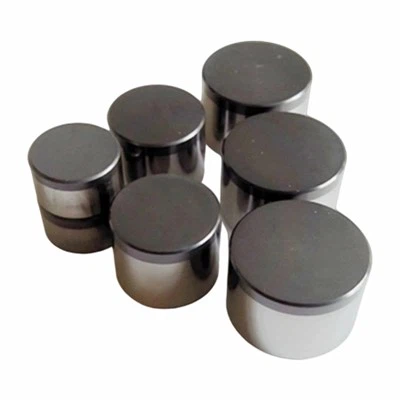
In drilling engineering for oil and gas exploration and development, the drill bit, as a tool for directly breaking formations, directly determines drilling efficiency and operating costs. Since its introduction in the 1970s, the Polycrystalline Diamond Compact (PDC) cutter, with its superior wear resistance and cutting ability, has gradually become a core technological component in the oil and gas drilling field, reshaping the technological paradigm of hard rock drilling.
The PDC cutter is essentially an ultra-hard composite material component. Its basic structure consists of a surface polycrystalline diamond layer and a cemented carbide matrix sintered under high temperature and high pressure. The polycrystalline diamond layer, formed by sintering micron-sized diamond particles through a metal catalyst to create a continuous three-dimensional network structure, possesses a hardness close to that of natural diamond (Vickers hardness reaching 8000–10000 HV) and excellent thermal stability. The cemented carbide matrix provides mechanical support and impact toughness, mitigating the high-frequency impact loads borne by the diamond layer during drilling. This "rigid-flexible" composite design allows the PDC cutter to efficiently shear soft to medium-hard formations with its sharp cutting edge, while also resisting the abrasion and impact of hard rock. This overcomes the limitations of traditional tungsten carbide drill bits, which suffer from low drilling efficiency and short lifespan in hard formations.
In terms of working principle, the PDC cutter abandons the impact-crushing mode of roller cone drill bits, employing a continuous scraping and shearing rock-breaking mechanism. As the drill bit rotates and advances, the diamond layer of the PDC cutter adheres to the rock surface at the bottom of the well with constant pressure. The shearing force generated by the high-speed relative motion causes plastic deformation and micro-crack propagation in the rock, ultimately breaking it down into fragments. Compared to impact-crushing, the scraping mode significantly reduces energy consumption, especially in homogeneous sandstone, shale, and some limestone formations, achieving higher rates of penetration (ROP) and lower energy consumption ratios. Experimental data shows that, under the same conditions, the average mechanical drilling speed of PDC drill bits can reach 2 to 5 times that of roller cone drill bits, and the footage per drill bit can be increased by 3 to 10 times, significantly shortening the drilling cycle.
The performance advantages of PDC cutters are closely related to their geometric parameter design. The shape (circular, conical, axe-shaped, etc.), diameter, diamond layer thickness, and cutting edge height of the cutter need to be customized according to the formation characteristics: for hard and brittle formations, small-diameter cutters with thick diamond layers are used to enhance impact resistance; for soft and plastic formations, large-diameter cutters with thin diamond layers are selected to improve cutting efficiency. In addition, the tooth density and arrangement of the cutter (such as radial or spiral) must match the profile of the drill bit crown to ensure uniform coverage at the bottom of the well and reduce repeated cutting and uneven wear.
Through decades of technological iteration, PDC cutters have evolved from a single rock-breaking element into a system engineering project integrating materials science, mechanical design, and manufacturing processes. Its widespread application in oil and gas drilling has not only driven the advancement of drilling technologies for deep wells, ultra-deep wells, and complex formations, but has also become a key support for reducing exploration and development costs and improving energy acquisition efficiency. In the future, with the development of nanodiamond composite technology and graded functional material preparation processes, the performance boundaries of PDC cutters will continue to expand, providing stronger tool support for oil and gas resource development under extreme geological conditions.