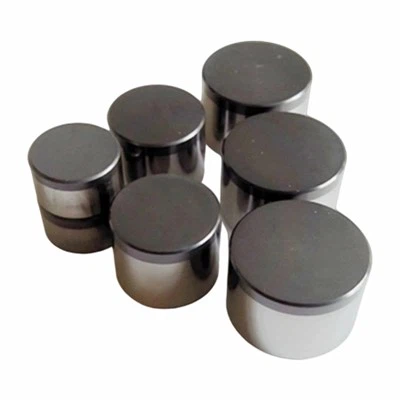
The performance of PDC (Polycrystalline Diamond Composite) cutters for oil and gas engineering embodies the deep integration of materials science and drilling engineering needs. Its core indicators encompass hardness, wear resistance, rock-breaking efficiency, thermal stability, and impact resistance, collectively ensuring reliable operation in complex drilling environments.
Regarding hardness and wear resistance, the surface layer of the PDC cutter is composed of polycrystalline diamond. Diamond particles are sintered under high temperature and pressure to form a continuous three-dimensional network structure, achieving a hardness of 8000–10000 HV Vickers, far exceeding that of traditional tungsten carbide teeth. This characteristic effectively resists erosion during formation cutting, maintaining a sharp and intact cutting edge, thus sustaining stable rock-breaking performance over extended periods and significantly extending drill bit life.
Rock-breaking efficiency is a prominent performance advantage of PDC cutters. They employ a continuous shearing mechanism rather than impact crushing. The high-speed relative motion between the diamond layer and the bottom rock surface generates shear force, causing plastic deformation and micro-crack propagation in the rock, ultimately breaking it down into fragments. This method boasts low energy consumption and smooth cutting, making it particularly suitable for soft to medium-hard homogeneous formations. Mechanical drilling speeds can reach 2-5 times that of roller cone bits, significantly increasing the footage per bit.
Thermal stability ensures sustained performance under high-temperature conditions. Diamond has an extremely low coefficient of thermal expansion and excellent thermal conductivity, allowing for rapid heat dissipation during high-speed cutting and suppressing the graphitization tendency of the diamond layer. This ensures stable cutting capability even in high-temperature environments or high-speed operations in deep wells.
Impact resistance and load-bearing capacity are enhanced by the composite structural design. The cemented carbide matrix provides high-strength support and toughness buffer for the diamond layer, effectively absorbing and dispersing impact loads and bending stresses from the wellbore, preventing brittle spalling or fracture of the surface layer. This allows the cutter to maintain a longer service life even in hard interlayers or gravel-bearing formations.
Furthermore, geometric designability expands the performance applicability range. By adjusting the cutter shape, size, diamond layer thickness, and array arrangement, the cutting trajectory and load distribution can be optimized for different lithologies and drilling processes, achieving a balance between efficient rock breaking and structural durability.
In summary, the PDC cutter, with its comprehensive performance including ultra-hard wear resistance, high-efficiency shearing, thermal stability, strong load-bearing capacity, and customizability, has become a core tool in the oil and gas drilling field for addressing diverse geological challenges, providing a solid guarantee for improving drilling efficiency and reducing costs.