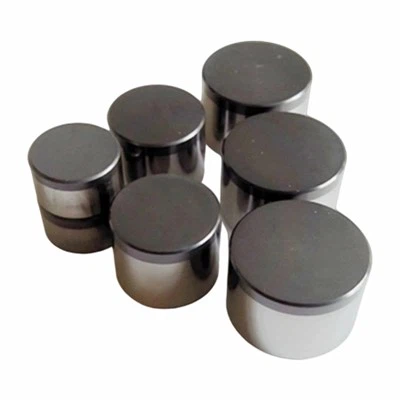
In mining engineering, facing complex and diverse ore and rock conditions and increasingly demanding mining efficiency requirements, the performance of rock-breaking tools has become a key factor restricting the speed of tunneling and mining. PDC (Polycrystalline Diamond Composite) cutters, as cutting components based on ultra-hard composite materials and unique rock-breaking mechanisms, have demonstrated significant advantages in mining drilling, tunneling, and hard rock mining, becoming an important technical support for efficient operations in modern mines.
The core structure of a PDC cutter for mining engineering consists of a surface polycrystalline diamond layer and a cemented carbide matrix. The polycrystalline diamond layer is formed by sintering micron-sized diamond particles under high temperature and pressure to create a continuous three-dimensional network structure. It achieves a Vickers hardness of 8000–10000 HV, exhibiting excellent wear resistance and scratch resistance. The cemented carbide matrix, with tungsten carbide as the skeleton and cobalt as the binder phase, provides high strength support and impact toughness, buffering frequent impact loads and bending stresses during mining operations and preventing the diamond layer from fracturing due to excessive brittleness. The two layers are metallurgically bonded to form a strong interface, ensuring uniform load distribution and structural stability, achieving both high hardness and toughness.
Its working principle differs from traditional impact crushing methods, employing continuous shear cutting. As the cutter advances with the drill bit, the diamond layer adheres to the ore surface with constant pressure. The shear force generated by the high-speed relative motion causes plastic deformation and microcrack propagation in the rock, ultimately peeling it off into fragments. This mechanism results in low energy loss and stable cutting, significantly improving drilling speed and reducing energy consumption per unit depth in homogeneous sandstone, shale, limestone, and some hard and brittle ores. It is particularly suitable for continuous operations such as coal mine gas extraction holes, metal ore exploration holes, and tunnel excavation.
The performance advantages of PDC cutters for mining engineering are multifaceted: First, they possess strong wear resistance, maintaining a sharp cutting edge even under diamond layers, extending drill bit replacement cycles. Second, they exhibit excellent thermal stability; the low coefficient of thermal expansion and high thermal conductivity of diamond minimize thermal damage under high-temperature or high-speed cutting conditions. Third, they offer strong adaptability; through optimization of geometry (circular, conical, axe-shaped, etc.), size, and array layout, cutting schemes can be customized for different rock hardness and structural characteristics, achieving efficient rock breaking and wellbore (hole) regularity. Fourth, they offer high overall efficiency; high drilling speed and long lifespan reduce non-productive time and material consumption, significantly shortening construction time and reducing costs in deep-hole drilling and large-scale mining.
Compared to roller cone or carbide insert bits, PDC cutters offer significant advantages in rock-breaking efficiency and lifespan in soft to medium-hard ores. Even in hard rock or gravel formations, good performance can be maintained by thickening the diamond layer and optimizing matrix toughness. Their stable cutting trajectory also helps control borehole deviation, meeting the needs of directional drilling and precision mining.
Overall, PDC cutters for mining engineering, with their ultra-hard composite structure, shear-breaking mechanism, and customizable design as their core technologies, play an irreplaceable role in improving drilling efficiency, reducing operating costs, and expanding the ability to mine complex ores. They are gradually becoming the mainstream choice for efficient and reliable rock-breaking tools in modern mining engineering.