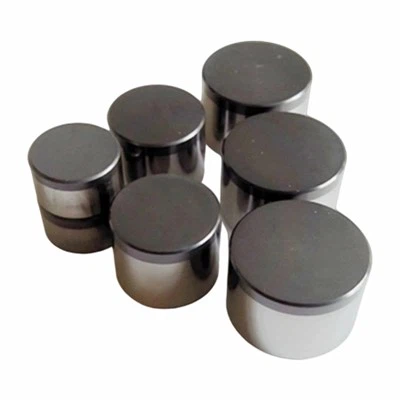
As high-hardness, high-precision rock-breaking components, the quality of PDC (polycrystalline diamond composite) cutters for mining engineering directly determines drilling efficiency, service life, and operational safety.Given their complex structure, sensitive performance, and harsh operating environment, quality control must be a comprehensive system covering the entire process, from raw material selection to field application. Through scientific testing and process control, every product must meet design and usage requirements.
In the raw material control stage, the quality of the polycrystalline diamond layer is based on the quality of high-purity synthetic diamond micron powder and the metal catalyst. Strict testing of the diamond powder's particle size distribution, crystal integrity, and impurity content is necessary to ensure uniform particle size and the absence of excessive sharp defects, preventing stress concentration points after sintering. The composition ratio and purity of the metal catalyst also need to be verified to avoid impurities affecting the bonding strength between diamond particles. The raw materials for the cemented carbide matrix should meet the specified tungsten carbide grain size and cobalt content requirements to ensure the matrix has both sufficient hardness and good toughness.
Process control during synthesis is crucial for ensuring the overall performance of the polycrystalline diamond layer and composite sheet. The high-temperature, high-pressure sintering process must be performed on precision equipment, requiring real-time monitoring and stable control of the uniformity of the temperature and pressure fields to prevent abnormal grain growth, porosity, or crack defects caused by localized overheating or insufficient pressure. During the secondary sintering process to bond the diamond layer and the cemented carbide matrix, the heating rate, holding time, and cooling curve must be optimized to control the thickness of the interfacial reaction layer and the level of residual stress, thereby achieving a strong metallurgical bond and stable mechanical properties.
Machining and geometric precision control directly affect the assembly and performance of the cutter. Superhard tools such as diamond wheels should be used during cutting, grinding, and polishing to prevent surface damage. Dimensional tolerances, cutting edge height, and geometric tolerances must conform to design specifications to ensure uniform coverage and load balance when multiple cutters are positioned on the drill bit crown. The processing environment must be clean to prevent dust and foreign matter from embedding in the diamond layer surface and affecting cutting performance.
Multi-level inspection standards must be established for quality inspection and sorting. The diamond layer's grain structure and interface bonding are observed using optical and scanning electron microscopes. Surface performance is evaluated using microhardness testers and abrasion testing machines. Precise measurements of geometric dimensions and surface roughness are performed, and non-destructive testing (such as ultrasonic and X-ray) is used to identify internal cracks and poor bonding. Qualified cutters are graded according to performance for targeted matching during selection; non-conforming products are isolated, their causes analyzed, and feedback fed back to the preceding process for correction.
Assembly and factory control are equally critical. During drill bit assembly, it is essential to ensure a secure bond between the cutter and the substrate, accurate positioning, and that the array layout meets the requirements of the cutting trajectory and load distribution. Before leaving the factory, a low-speed test run and visual inspection should be conducted to confirm the absence of looseness and damage. Detailed performance parameters and applicable operating conditions are provided to facilitate correct use and maintenance in the field.
Quality tracking in field applications is an extension of quality control. By establishing usage records to document lithological conditions, drilling parameters, cutter wear status, and replacement reasons, batch-related or design-related quality issues can be identified promptly, forming a closed-loop improvement mechanism. Failure analysis of repaired or decommissioned cutters can provide a basis for material formulation and process optimization.
In summary, quality control of PDC cutters for mining engineering is a systematic project that spans the entire process from material preparation, synthesis, processing, testing to application. Only by adhering to precise testing and process optimization at every stage can we ensure the stable performance of its ultra-hard, wear-resistant, and high-strength load-bearing properties, providing a reliable guarantee for efficient, safe, and economical mining.