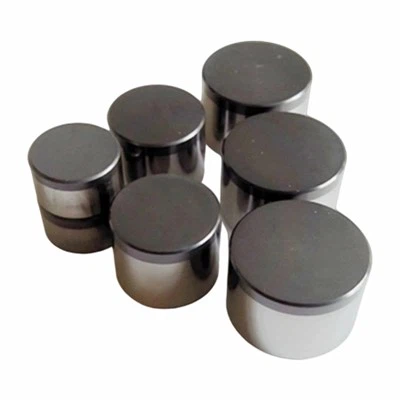
In modern high-end manufacturing, material processing faces challenges from complex environments such as high temperatures, high loads, and strong corrosion, gradually revealing the performance limitations of traditional tool materials.Polycrystalline diamond (PCD), with its ultra-high hardness and wear resistance, has become the preferred solution for difficult-to-machine materials. The emergence of thermally stable PCD further overcomes the limitation of conventional PCD's tendency to graphitize and fail above 300℃, opening new paths for precision machining under extreme conditions.
Through optimized sintering processes and composition design, thermally stable PCD raises the thermal decomposition temperature to over 700℃ while maintaining the high bonding strength of the diamond phase, allowing it to maintain cutting edge sharpness and structural integrity even in sustained high-temperature environments. This characteristic makes it particularly suitable for machining titanium alloys and nickel-based superalloys in the aerospace field-these materials have poor thermal conductivity and severe work hardening, easily generating localized high temperatures in the cutting zone. Conventional tools often fail rapidly due to thermal wear, while thermally stable PCD can extend tool life by 3 to 5 times, significantly improving machining efficiency and economy.
Its application value is equally prominent in energy equipment manufacturing. For example, ultra-hard composite drill bits used in shale gas development need to operate for extended periods under high temperatures of hundreds of degrees Celsius and impact loads downhole. The thermal fatigue resistance of thermally stable PCD effectively resists cyclic thermal stress and reduces the risk of tool breakage. In geothermal well drilling, facing environments containing corrosive media such as hydrogen sulfide, its stable chemical inertness also prevents accelerated tool wear due to corrosion. Furthermore, in the processing of new energy components in the automotive industry (such as silicon steel sheets for motors and molds for silicon carbide-based power devices), the instantaneous high temperatures generated by high-speed cutting place stringent requirements on the thermal stability of the cutting tools. The low coefficient of thermal expansion and thermal shock resistance of thermally stable PCD ensure consistent machining accuracy.
From a technological evolution perspective, the widespread adoption of thermally stable PCD not only depends on breakthroughs in the material itself but also requires deep adaptation to machining processes. Currently, its application in precision grinding and interrupted cutting still requires optimized parameter matching. However, with advancements in synthesis technology and post-processing techniques, its applicable environments are extending from single high-temperature scenarios to multi-field coupled conditions of "high temperature + impact + corrosion". It is foreseeable that this superhard material, which combines extreme hardness and thermal toughness, will become a key support for the high-end equipment manufacturing industry to break through the processing limits, and will drive precision manufacturing to move towards more complex and demanding fields.