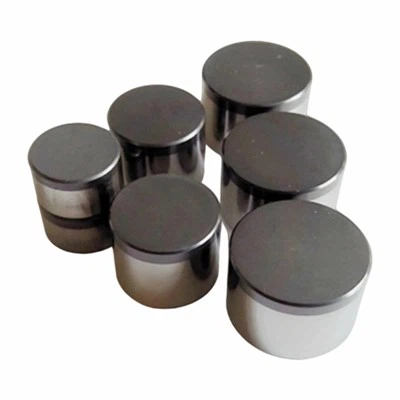
The development and application of PDC (polycrystalline diamond composite) cutters for mining engineering have not only significantly improved rock-breaking efficiency and operational reliability in engineering practice, but also demonstrated the innovative value generated by the deep intersection of materials science, mechanics, manufacturing processes, and mining engineering at the scientific level. Its scientific significance lies in breaking through the performance bottlenecks of traditional rock-breaking tools, establishing a quantifiable correlation between microscopic material design and macroscopic engineering performance, and providing a new theoretical paradigm and practical path for tool development under extreme working conditions.
From a materials science perspective, the core of the PDC cutter is the composite structure of a polycrystalline diamond layer and a cemented carbide matrix. Polycrystalline diamond is formed by sintering micron-sized diamond particles under high temperature and high pressure conditions through a metal catalyst to form a continuous three-dimensional network. Its hardness is close to that of natural diamond, and its wear resistance far exceeds that of conventional cemented carbide. However, the brittleness of single diamond limits its application under impact loads. Researchers have achieved a synergistic effect of "ultra-hard and wear-resistant-strong and tough load-bearing" by introducing a cemented carbide matrix and optimizing the interfacial metallurgical bonding. This composite approach deepens the understanding of the interface bonding mechanism of heterogeneous materials, promotes the development of functionally graded materials and multiphase composite structure design theory, and provides a scientific model for the development of tool materials under other extreme working conditions.
In the study of mechanics and rock-breaking mechanisms, the PDC cutter abandons the impact-crushing mode of traditional roller cone drill bits, adopting continuous shear cutting. Scientific research, through experiments and numerical simulations, reveals that the essence of shear rock breaking is that the diamond layer acts on the rock surface with constant pressure, and the shear stress generated by high-speed relative motion causes plastic deformation and microcrack propagation in the rock, ultimately peeling it off into fragments. This process transforms the macroscopic rock-breaking problem into an analyzable stress field and crack evolution problem, deepening the understanding of rock cutting mechanics and promoting the refinement of rock-tool interaction models, laying a theoretical foundation for optimizing cutting parameters and predicting rock-breaking efficiency.
Advances in manufacturing process science are also an important component of the scientific significance of the PDC cutter. The parameter control of the high-temperature, high-pressure sintering process (temperature field, pressure field uniformity, and holding time) directly affects the grain size and density of the polycrystalline diamond layer; the secondary sintering of the composite sheet and the matrix involves interfacial diffusion, residual stress regulation, and bond strength optimization. These process studies have promoted the development of thermodynamics and kinetics in superhard material preparation, improved the control precision of precision hot pressing equipment, and formed a reusable process-structure-performance correlation database, providing a scientific basis for the industrial production of other superhard composite components.
At the level of applied science in mining engineering, the field application of the PDC cutter has verified its adaptability under different rock and ore conditions. Based on this, researchers have established a matching model of lithology, cutter parameters, and drilling efficiency, shifting the selection of rock-breaking tools from experience-driven to data- and theory-driven. This not only improves the design accuracy and operational efficiency of mining engineering but also provides scientific support for deep mining, hard rock tunneling, and resource development under complex geological conditions, promoting the transformation of mining engineering from extensive to refined and intelligent methods.
Furthermore, the research on the PDC cutter has promoted the formation of a multidisciplinary collaborative innovation paradigm. Materials scientists, mechanics researchers, manufacturing engineers, and mining technicians collaborated on a common research topic, forming a complete innovation chain from basic research to engineering applications. This model breaks down disciplinary barriers, accelerates the transformation of scientific research results into productivity, and reflects the positive interaction between scientific leadership and engineering feedback in the development of modern engineering technology.
In summary, the scientific significance of PDC cutters for mining engineering lies not only in their improved performance but also in their role as a vehicle for interdisciplinary research. They deepen our understanding of superhard composite materials, rock cutting mechanics, precision manufacturing processes, and their adaptability to mining engineering. This provides theoretical support and methodological inspiration for tool design under extreme conditions and complex resource development, demonstrating the fundamental driving force of scientific innovation for engineering progress.