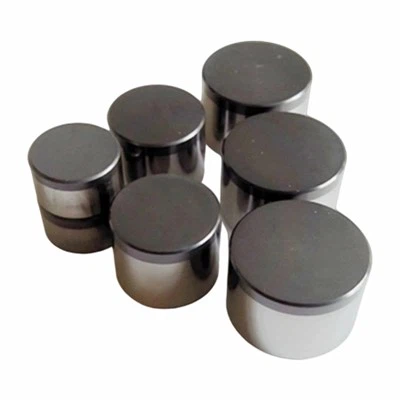
The performance advantages of thermally stable polycrystalline diamond (PCD) stem from its meticulous composition design and preparation process. It is not simply a matter of stacking diamond powder, but rather a combination of carefully selected raw materials, optimized binding phases, and special post-treatment to construct a superhard composite material that maintains the stability of the diamond phase and structural integrity at high temperatures. Understanding its composition methods helps to grasp the essence of material performance formation and provides a theoretical basis for application selection.
At the raw material level, thermally stable PCD uses high-purity single-crystal diamond micron powder as its core component. The particle size is typically controlled in the micrometer to submicrometer range, and a uniform particle size distribution is obtained through rigorous sieving. A more uniform particle size helps to form a dense and continuous grain boundary network, reducing local weak points caused by significant differences in particle size. The crystal form of the raw material also needs to be optimized; a complete crystal form can increase the contact area and bonding strength between particles, laying a good foundation for subsequent sintering.
The composition of the binding phase is crucial in determining thermal stability. Conventional PCD (polycrystalline diamond) typically uses transition metals such as cobalt and nickel as catalysts and binders. These metals catalyze the transformation of diamond to graphite at high temperatures, limiting the operating temperature. Thermally stable PCD involves significant adjustments to its composition: reducing the content of the catalytic metal and introducing ceramic or carbide-based non-metallic binding phases, such as silicides, borides, or nitrides. These binding phases do not participate in the catalytic graphitization reaction and maintain chemical and mechanical stability at high temperatures, thus significantly increasing the material's thermal decomposition temperature.
The sintering process is the core step in forming a robust composite structure between diamond particles and the binding phase. High-temperature, high-pressure (HPHT) conditions allow diamond microparticles to undergo plastic flow and interlocking under the guidance of the binding phase, forming a three-dimensional network framework. This process requires precise control of temperature, pressure, and time to ensure sufficient intergranular bonding while avoiding excessive heat input that could lead to pre-graphitization.
Post-treatment is an important supplementary step in imparting thermal stability. Common methods include high-temperature vacuum or protective atmosphere annealing, which promotes the diffusion, aggregation, or deactivation of residual catalytic metals, reducing their catalytic activity at grain boundaries. Some processes also incorporate surface oxidation or coating deposition to further enhance oxidation and corrosion resistance. These post-treatments do not react violently with the diamond matrix but significantly improve the material's stability under alternating heat loads.
In summary, the composition method for thermally stable PCD integrates the selection of high-quality diamond powder, the design of low-catalysis or non-metallic binding phases, precise HPHT sintering control, and targeted post-treatment processes. This multi-stage synergistic effect allows it to retain the ultra-hard properties of diamond while exhibiting excellent structural and performance retention capabilities in high-temperature environments, providing a reliable material basis for processing under extreme conditions.