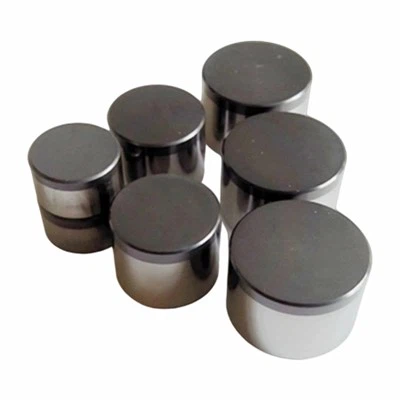
The effectiveness of PDC (Polycrystalline Diamond Composite) cutters in mining engineering depends not only on their material and structural advantages but also on a methodological system tailored to the specific conditions of the mine. This system encompasses selection and matching, deployment planning, operation control, and maintenance management, aiming to transform the cutter's performance potential into stable and reliable on-site operational capabilities, achieving a balance between efficient rock breaking and engineering objectives.
In terms of selection and matching, the physical and mechanical properties of the ore and rock should be the core basis. Core sampling and laboratory testing are necessary to determine the hardness, abrasiveness, bedding development, and distribution of gravel or fractures in the ore and rock. Based on this, the diamond layer thickness, grain size composition, and matrix toughness grade should be determined. For homogeneous medium-hard sandstone or shale, a standard circular cutter with a moderate diamond layer thickness can be used to ensure a balance between wear resistance and impact resistance. For hard, brittle limestone or gravelly interlayers, the diamond layer thickness should be increased, and a high-toughness matrix should be preferred. If necessary, conical or axe-shaped cutters should be used to enhance local penetration. This method emphasizes "material selection based on local conditions" to avoid efficiency losses and shortened lifespan caused by excessive or insufficient performance.
The layout planning method focuses on cutting coverage and load balance. Multiple cutters must be arranged in a radial or spiral array according to the drill bit crown profile and wellbore (hole) trajectory requirements, controlling the spacing and cutting edge height to ensure uniform stress and continuous cutting trajectory at the bottom of the well or hole. In hard rock sections, the tooth density can be appropriately increased to enhance rock-breaking capacity, while in soft rock sections, the tooth density can be moderately increased to facilitate chip removal and heat dissipation. The layout method must also consider the rotational balance of the drill string to prevent vibration and deviation caused by uneven load, ensuring a regular hole and convenient subsequent support.
The operation control method emphasizes parameter coordination and process monitoring. Reasonable drilling pressure, rotation speed, and pump flow rate should be set according to the rock conditions and cutter characteristics to fully utilize the shearing rock-breaking mechanism and avoid overload impact leading to diamond layer fracture or matrix fatigue. In deep hole or high-temperature operating environments, it is necessary to monitor changes in cutting temperature and torque and adjust parameters in a timely manner to prevent thermal damage. For directional drilling or large-displacement holes, a progressive parameter switching method can be used to ensure that trajectory accuracy and cutting efficiency meet standards simultaneously.
Operation and maintenance management is a key aspect of ensuring continuous usability. A regular inspection system should be established to observe surface wear of the cutter, the integrity of the diamond layer, and the condition of matrix cracks. Rock cuttings and sediments should be cleaned promptly to prevent secondary wear. Cutters with excessive wear or damage should be replaced or repaired, and the selection and deployment scheme should be optimized based on data from previous operations. This method emphasizes "inspection-driven use and use-driven optimization," forming a closed-loop improvement mechanism.
The method of using PDC cutters in mining engineering essentially involves, based on a thorough understanding of the characteristics of the ore and tools, scientifically selecting, rationally deploying, precisely controlling, and systematically maintaining the cutter, transforming its ultra-hard wear resistance and high-efficiency shearing advantages into predictable engineering outputs. This method not only improves rock-breaking efficiency and drill bit life but also provides a replicable technical path for safe and economical mining under complex ore conditions.